

Eocene Magnetic Field Reversals are reshaping scientific understanding of how Earth’s magnetic shield behaves over deep time. New research based on sediment cores from the North Atlantic reveals that two geomagnetic flips during the Eocene Epoch lasted far longer than previously believed. Instead of completing within roughly 10,000 years — the long-accepted average — these Eocene Magnetic Field Reversals stretched to 18,000 years and an astonishing 70,000 years.
These findings suggest that Earth’s magnetic field, which protects the planet from harmful cosmic radiation, may be far more unpredictable than once thought. The implications touch everything from atmospheric chemistry to biological evolution.
Drilling into Deep Time
The groundbreaking evidence comes from sediment cores extracted off the coast of Newfoundland in the North Atlantic Ocean. These cores were collected during a 2012 drilling expedition focused on understanding climate changes during the Eocene Epoch, which lasted from about 56 to 34 million years ago.
The research team, led by Yuhji Yamamoto of Kochi University in Japan and Peter Lippert of the University of Utah, examined layers of sediment up to 300 meters beneath the seafloor. These layers act as geological time capsules. Grain by grain, they recorded Earth’s environmental and magnetic history.
Tiny crystals of magnetite — produced by ancient microorganisms and transported by dust and erosion — align with Earth’s magnetic field at the time of deposition. Once locked into sediment, they preserve the direction and intensity of the field. By measuring these magnetic signatures, scientists can reconstruct geomagnetic reversals with remarkable precision.
It was within these carefully analyzed layers that Eocene Magnetic Field Reversals displayed unexpected timing “hiccups.”
What Is a Geomagnetic Reversal?
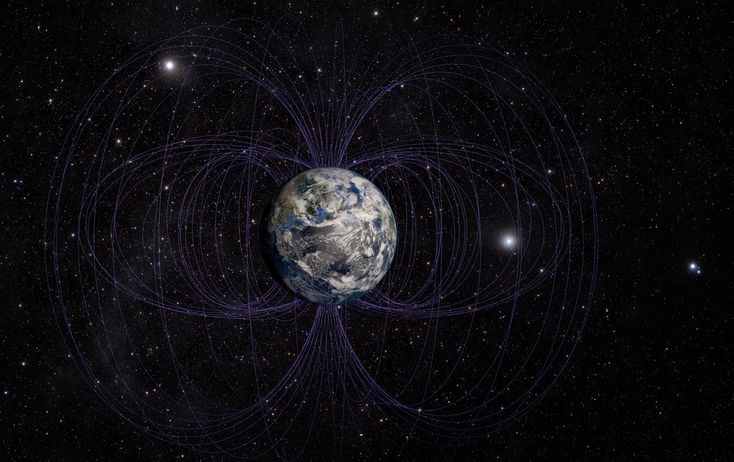
Earth’s magnetic field is generated deep within the planet by the movement of molten iron and nickel in the outer core. This swirling motion creates electric currents that power the geodynamo — the engine behind the magnetic field.
Occasionally, the north and south magnetic poles swap places in what scientists call a geomagnetic reversal. Historically, most reversals studied over the past 170 million years appeared to take roughly 1,000 to 12,000 years to complete, depending on latitude.
A typical reversal follows three stages:
- A precursor phase lasting up to 2,500 years
- A main transition phase of about 1,000 years
- A rebound phase lasting another 2,500 years
Together, these phases usually result in a total duration of up to 10,000 years.
However, the newly identified Eocene Magnetic Field Reversals do not follow this standard model.
The 18,000-Year and 70,000-Year Anomalies
In one eight-meter-thick section of sediment core, researchers found a prolonged period of unstable magnetic polarity sandwiched between two stable orientations. Detailed analysis confirmed that this instability represented two separate reversals.
One reversal lasted approximately 18,000 years — nearly double the conventional estimate. The second stretched to an extraordinary 70,000 years.
Such drawn-out reversals challenge earlier models of Earth’s core dynamics. Prior models relied on data from 540 reversals over the last 170 million years. Those records suggested relatively consistent durations.
The Eocene Magnetic Field Reversals indicate that Earth’s magnetic behavior may have always been more erratic than scientists assumed.
Why Duration Matters
The length of a geomagnetic reversal is not just a geological curiosity. It has real planetary consequences.
During a reversal, Earth’s magnetic field weakens significantly. The magnetosphere — the protective shield deflecting charged particles from the solar wind — becomes less effective. As a result, higher levels of cosmic radiation can penetrate the atmosphere.
If a reversal lasts 70,000 years instead of 10,000, the planet experiences prolonged exposure to radiation. According to researchers, this could:
- Increase mutation rates in living organisms
- Alter atmospheric chemistry
- Contribute to atmospheric erosion
- Affect animal navigation systems
- Influence climate patterns
The Eocene period was already marked by shifting climates, tectonic activity, and evolving ecosystems. Extended weakening of the magnetic field during Eocene Magnetic Field Reversals may have played a subtle yet important role in shaping evolutionary pathways.
Insights into Earth’s Dynamo
Modern computer simulations of Earth’s geodynamo show that reversals can vary widely in duration. Some are short, while others stretch tens of thousands of years. In rare cases, models suggest transitions lasting up to 130,000 years.
The new sediment core evidence supports these broader simulation outcomes.
This means Earth’s core activity — the churning motion of molten metals that generates the magnetic field — may operate with greater variability than older models predicted.
The finding suggests that reversals are intrinsic to core dynamics and not triggered by a single external cause. Scientists still do not know what precisely initiates a reversal, but evidence now shows that duration is not fixed.
The Eocene Context
The Eocene Epoch was a dynamic chapter in Earth’s history. The early Rocky Mountains were in place, the Himalayas were forming, and continental rearrangements were ongoing. Climate regimes were shifting, and life was diversifying.
In this already changing world, prolonged Eocene Magnetic Field Reversals may have introduced additional environmental stressors.
If higher radiation levels persisted for tens of thousands of years, biological systems would have had to adapt. While no mass extinction is directly tied to these specific reversals, subtle evolutionary pressures cannot be ruled out.
The rock record continues to preserve clues waiting to be decoded.
Looking Ahead
The discovery of these unusually long Eocene Magnetic Field Reversals opens the door to further investigation. More sediment cores from different regions and time periods will help determine whether such prolonged reversals were rare anomalies or more common than previously recognized.
If similar patterns emerge in other geologic intervals, scientists may need to revise the long-standing assumption that 10,000 years is the typical duration of a geomagnetic flip.
Understanding magnetic reversals is not merely academic. Earth’s magnetic field remains essential for protecting modern civilization from radiation hazards that could disrupt satellites, power grids, and communications.
While there is no immediate evidence that a reversal is imminent, studying ancient events provides critical context for interpreting future magnetic changes.
The new research underscores one important reality: Earth’s magnetic field is dynamic, complex, and sometimes unpredictable.
This report is based on findings published by Universe Today. Additional scientific background on geomagnetic reversals and Earth’s magnetic field can be explored through NASA and university geophysics research publications. For more science and astronomy coverage, visit the homepage at FFRNEWS and explore related updates in the Astronomy section.