
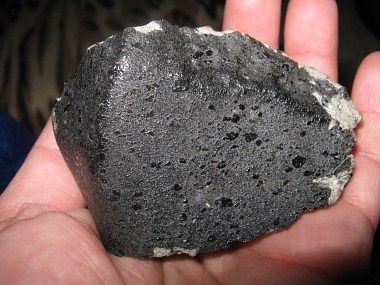
Hidden water in Martian meteorite samples has long been suspected, but a new scientific breakthrough has finally confirmed its presence in remarkable detail. Using advanced neutron and X-ray scanning technology, planetary scientists have uncovered previously invisible water-bearing minerals inside one of the most famous Martian meteorites ever discovered — NWA 7034, commonly known as Black Beauty.
The discovery adds powerful new evidence to the growing body of research suggesting that Mars once hosted widespread liquid water billions of years ago. It also demonstrates how non-destructive technology is transforming the way scientists study rare and invaluable extraterrestrial material.
Why the Black Beauty Meteorite Is Scientifically Unique
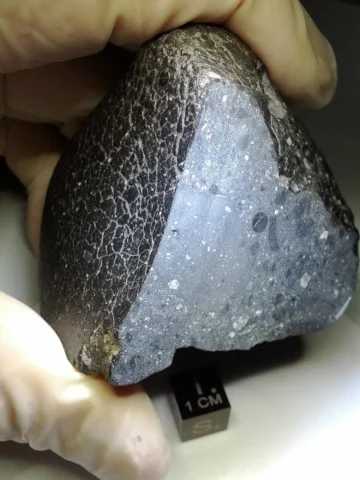
Black Beauty stands apart from other Martian meteorites due to both its age and composition. Estimated to be around 4.48 billion years old, it contains some of the oldest known material from the Red Planet. Unlike volcanic Martian meteorites, Black Beauty is a breccia — a rock made up of multiple fragments fused together during violent impacts on Mars’ surface.
This structure preserves a long and complex geological timeline, making the meteorite a natural archive of early Martian history. Scientists believe the rock was blasted off Mars by a massive asteroid impact before eventually landing on Earth thousands of years later.
Because of its rarity and scientific importance, researchers have always faced a difficult tradeoff: study the meteorite in detail or preserve it intact for future generations.
How New Scanning Technology Changed Everything
Previous research on Black Beauty often required cutting or dissolving portions of the meteorite to analyze its chemical makeup. While effective, those methods permanently destroyed parts of an irreplaceable sample.
The new study, led by Estrid Naver from the Technical University of Denmark, applied two non-destructive imaging techniques instead:
- X-ray computed tomography (CT), commonly used in medical imaging, which excels at detecting dense elements such as iron and titanium
- Neutron CT scanning, a less common but highly powerful method capable of detecting hydrogen — a key indicator of water
Neutron scans are especially valuable in planetary science because hydrogen is difficult to detect using traditional imaging. By combining both methods, scientists were able to see deep inside the meteorite without altering or damaging it.
Hydrogen-Rich Clasts Reveal Hidden Water
The scans revealed small embedded rock fragments known as clasts, which scientists have known existed inside Black Beauty for decades. What surprised researchers was the discovery of a specific type of clast never previously identified in the meteorite.
These newly detected fragments are composed of hydrogen-rich iron oxyhydroxide, often shortened to H-Fe-ox. Although these clasts make up only about 0.4% of the scanned sample’s total volume, chemical analysis shows they contain up to 11% of the meteorite’s total water content.
This finding confirms that hidden water in Martian meteorite Black Beauty is not evenly distributed, but instead concentrated in distinct mineral structures formed under water-rich conditions.
What the Discovery Says About Ancient Mars
Black Beauty contains approximately 6,000 parts per million (ppm) of water, an unusually high concentration for material originating from modern-day Mars. The presence of hydrogen-rich clasts indicates that liquid water played a significant role in shaping the planet’s early crust.
Even more compelling is how closely these findings align with recent data from NASA’s Perseverance rover, which has identified hydrated minerals and sedimentary rock formations in Jezero Crater. Despite originating from different regions of Mars, both samples tell a consistent story: Mars once had a warm, wet environment capable of sustaining liquid water for extended periods.
This strengthens the hypothesis that early Mars may have had conditions suitable for microbial life.
A Natural Mars Sample Return Mission
Scientists often describe Black Beauty as a Mars sample return mission in a single rock. Unlike rover-collected samples, which come from localized sites, meteorites like NWA 7034 contain material formed across different locations and eras of Martian history.
The success of non-destructive neutron scanning opens new possibilities for studying other Martian meteorites already housed in laboratories around the world. These techniques can even penetrate metal containers, meaning future Mars samples could be examined before being physically opened.
While NASA’s Mars Sample Return mission has recently been cancelled, a Chinese-led sample return mission is still planned. Until new samples arrive, researchers see enormous value in applying these advanced techniques to existing meteorites.
Why Non-Destructive Science Is the Future
Preserving rare planetary material is becoming increasingly important as scientific tools grow more powerful. Non-destructive imaging allows scientists to revisit samples multiple times, each time with improved technology and new research questions.
By revealing hidden water in Martian meteorite Black Beauty without damaging it, this study sets a new standard for planetary analysis. It ensures that future researchers will still have access to the same pristine material while continuing to uncover new insights about Mars’ past.
What Comes Next
Researchers plan to apply neutron CT scanning to other Martian meteorites to search for similar hydrogen-rich structures. Each discovery brings scientists closer to understanding how widespread water once was on Mars and how long it persisted.
As exploration technology advances, findings like this continue to reshape humanity’s understanding of the Red Planet — not as a lifeless desert, but as a world that once may have looked far more like Earth.
This Ambuzzway astronomy report is based on planetary science research highlighted by Universe Today, along with data from a pre-print study published on arXiv by researchers at the Technical University of Denmark. Additional scientific context is drawn from NASA’s Mars exploration programs and ongoing analysis of Martian meteorites.
Mars, Martian Meteorite, Black Beauty Meteorite, Hidden Water in Martian Meteorite, Space Discoveries, Astronomy News, Planetary Science, Mars Water Evidence, Ancient Mars, Space Research