Lionel Messi India event chaos unfolded dramatically at Kolkata’s iconic Salt Lake Stadium, turning what was meant to be a historic celebration of football into scenes of anger, vandalism, and political fallout. Thousands of devoted fans who had paid premium prices to witness the Argentine superstar in person were left disillusioned after Messi’s appearance lasted barely 20 minutes, prompting unrest that shocked both local authorities and the global football community.
The episode, which quickly dominated headlines and social media, has raised serious questions about event management, crowd expectations, security planning, and the commercialization of sports icons in high-emotion fan cultures like India’s.
Lionel Messi India Event Chaos: What Happened at Salt Lake Stadium
Salt Lake Stadium, officially known as Vivekananda Yuba Bharati Krirangan, is no stranger to massive crowds. As one of the largest football stadiums in the world, it has hosted historic matches, local derbies, and international events. On Saturday evening, it was expected to host something equally special: a rare in-person appearance by Lionel Messi as part of his much-publicized “GOAT Tour” of India.
Fans began gathering hours before kickoff. Many wore Argentina jerseys, Messi scarves, and headbands declaring their admiration. Some had traveled thousands of kilometers, spending savings equivalent to a month’s salary just for a fleeting chance to see the eight-time Ballon d’Or winner.
When Messi finally entered the pitch, the atmosphere was electric. He waved to the crowd, acknowledging chants that echoed across the stadium. But the joy was short-lived.
Surrounded tightly by politicians, celebrities, and officials, Messi remained largely obscured from public view. Within approximately 20 minutes, he was escorted off the field by security personnel. As it became clear that his appearance had ended, disappointment turned into outrage.
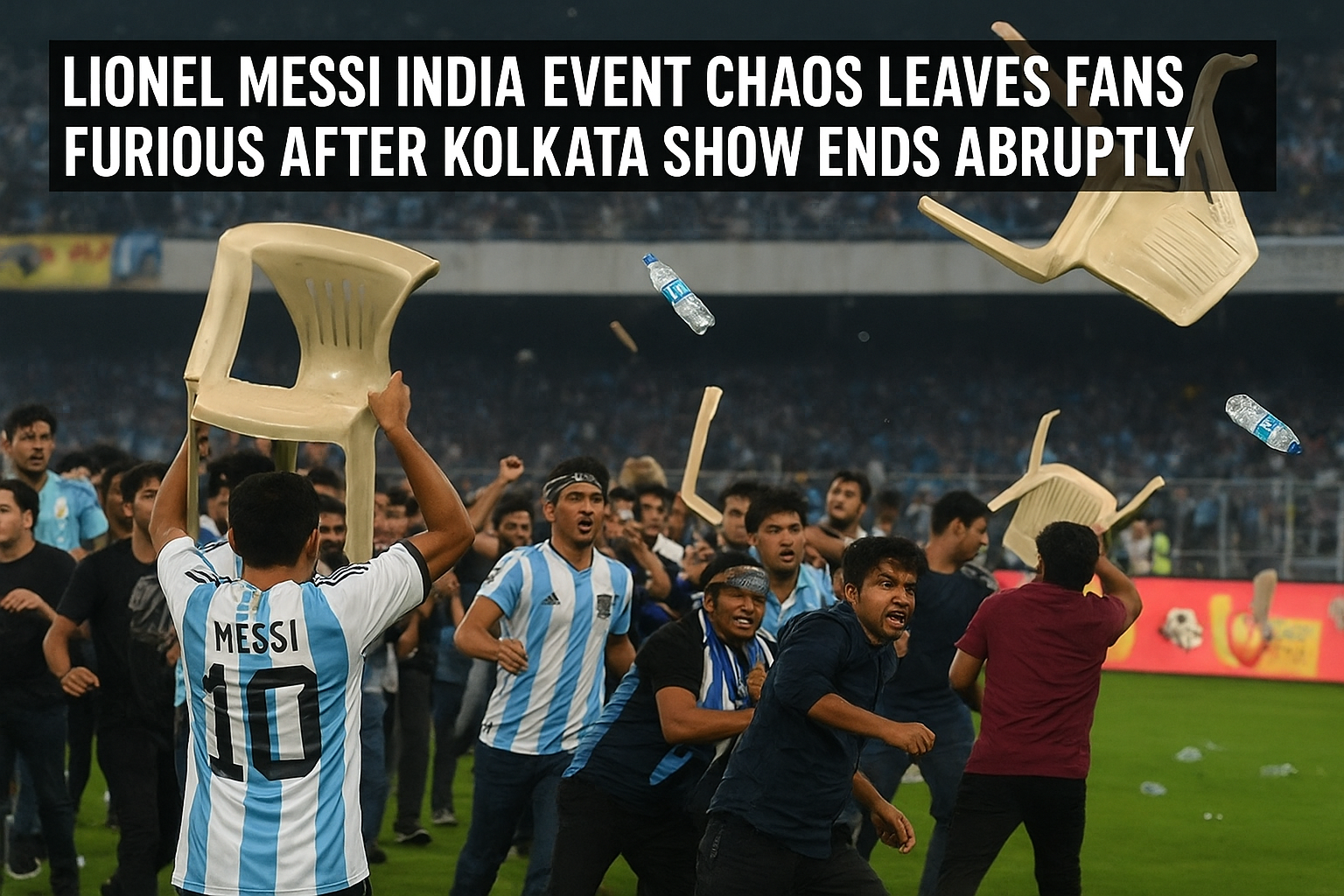
Plastic chairs were ripped from the stands. Bottles were thrown toward the pitch. Banners and tents were vandalized. Some fans stormed restricted areas, forcing police to intervene.
The Lionel Messi India event chaos had begun.
Why Fans Felt Betrayed
For many attendees, the anger stemmed not just from Messi’s brief appearance, but from expectations set by organizers. Reports from AFP and Indian media suggested that fans believed Messi would participate in a short exhibition game or spend extended time engaging with supporters.
Tickets reportedly cost between ₹5,000 and ₹12,000, a significant amount in a country where the average monthly income is far lower. Fans argued that the event had been marketed as a once-in-a-lifetime experience, not a fleeting walk-around.
One supporter told ANI:
“Only leaders and actors were surrounding Messi. Why did they call us then? We paid ₹12,000 and couldn’t even see his face.”
Another fan told Press Trust of India that he had brought his young son, hoping to inspire him through football.
“I came to see Messi, not politicians. The police were taking selfies while we were pushed back.”
Such sentiments explain why emotions boiled over so quickly once Messi left the stadium.
Messi’s Camp Responds to the Chaos
As videos of unrest circulated online, Messi’s representatives moved swiftly to clarify his position. A spokesperson stated that Messi had fulfilled all contractual obligations agreed upon in advance. According to his camp, the duration and nature of the appearance were pre-decided with organizers.
Regarding crowd management and expectations, Messi’s team referred inquiries to West Bengal Chief Minister Mamata Banerjee’s public apology.
This response highlighted a critical aspect of the Lionel Messi India event chaos: the disconnect between contractual commitments and public expectations.
Political Fallout and Government Response
West Bengal Chief Minister Mamata Banerjee described the scenes at Salt Lake Stadium as “deeply disturbing and shocking.” In a post on X (formerly Twitter), she apologized directly to Messi and to sports fans across India.
She also announced a formal inquiry into the incident.
“The enquiry committee will conduct a detailed enquiry into the incident, fix responsibility, and recommend measures to prevent such occurrences in the future,” Banerjee said.
Authorities later confirmed that the event’s “chief organizer” had been arrested, though details of the charges were not immediately disclosed. Police also stated that mechanisms were being explored to refund ticket holders, though logistical challenges remain.
The All India Football Federation (AIFF) distanced itself from the controversy, clarifying that the Messi appearance was a private promotional event and not organized under its supervision.
Lionel Messi India Event Chaos Highlights India’s Football Passion
While cricket dominates India’s sporting landscape nationally, cities like Kolkata possess a deep, almost religious devotion to football. Local derbies regularly draw massive crowds, and international stars enjoy cult-like followings.
In the days leading up to Messi’s arrival, thousands lined the roads outside his hotel, hoping for a glimpse. Earlier in the tour, a massive 70-foot statue of Messi was unveiled in Kolkata, constructed over 27 days by a 45-member crew. Due to security concerns, Messi appeared virtually for the unveiling — a decision that, in hindsight, foreshadowed the problems to come.
For fans like Hitesh, a 24-year-old lawyer who traveled nearly 1,900 kilometers from Bengaluru, Messi represented more than football.
“Messi gives me hope,” he told the BBC. “He shows that talent matters more than size or background.”
Such emotional investment magnifies disappointment when expectations are not met.
Celebrities, Security, and the Visibility Problem
One recurring complaint from fans was that Messi remained inaccessible and obscured throughout his time on the pitch. Surrounded by high-profile figures — including Bollywood superstar Shah Rukh Khan — Messi was visible mainly to VIP sections and cameras.
Security personnel reportedly blocked sightlines, and some fans claimed officials prioritized selfies over crowd safety.
This fueled perceptions that the event was designed more for elite networking and promotional imagery than for ordinary supporters.
The Lionel Messi India event chaos thus became a symbol of broader frustrations around exclusivity in modern sports events.
Economic and Reputational Costs
Beyond injuries and arrests, the incident carries economic and reputational consequences. Refunds could cost organizers millions of rupees. Future international sports events in India may face heightened scrutiny from both fans and global promoters.
For Messi, the episode represents an unfortunate blemish on what was intended as a goodwill tour celebrating his legacy. Though not personally responsible for crowd management, his brand is inevitably linked to the fallout.
For Indian authorities, the incident underscores the need for stricter regulation of private mega-events, especially those involving global celebrities.
Lessons from the Lionel Messi India Event Chaos
Several key lessons emerge from the Kolkata incident:
1. Clear Communication Is Essential
Organizers must clearly state what fans will and will not experience. Ambiguity breeds unrealistic expectations.
2. Crowd Management Cannot Be an Afterthought
High-emotion crowds require professional planning, trained stewards, and transparent security protocols.
3. Fan Experience Should Be Central
Events built around sports icons must prioritize visibility, accessibility, and engagement for paying supporters.
4. Accountability Builds Trust
Swift investigations, refunds, and public explanations are essential to restoring confidence.
What Happens Next
The enquiry committee announced by the West Bengal government is expected to submit findings in the coming weeks. Organizers may face further legal action, and compensation frameworks for affected fans are under discussion.
Messi’s remaining tour stops in Hyderabad, Mumbai, and Delhi will likely proceed under heightened security, with revised protocols to avoid a repeat of Kolkata’s chaos.
For Indian football fans, the incident is both heartbreaking and instructive — a reminder of their passion, but also of the responsibilities that come with hosting global icons.
Lionel Messi India Event Chaos: A Cautionary Tale
In the end, the Lionel Messi India event chaos was not merely about one footballer leaving early. It was about trust — between fans and organizers, between spectacle and substance, and between commercial ambition and genuine fan engagement.
Kolkata’s streets may have quieted, but the questions raised by that night will echo far beyond Salt Lake Stadium.
For further coverage:
👉 Related coverage on politics and governance:
https://ambuzzway.com/politics/
Source:
This report is based on information originally published by BBC News.