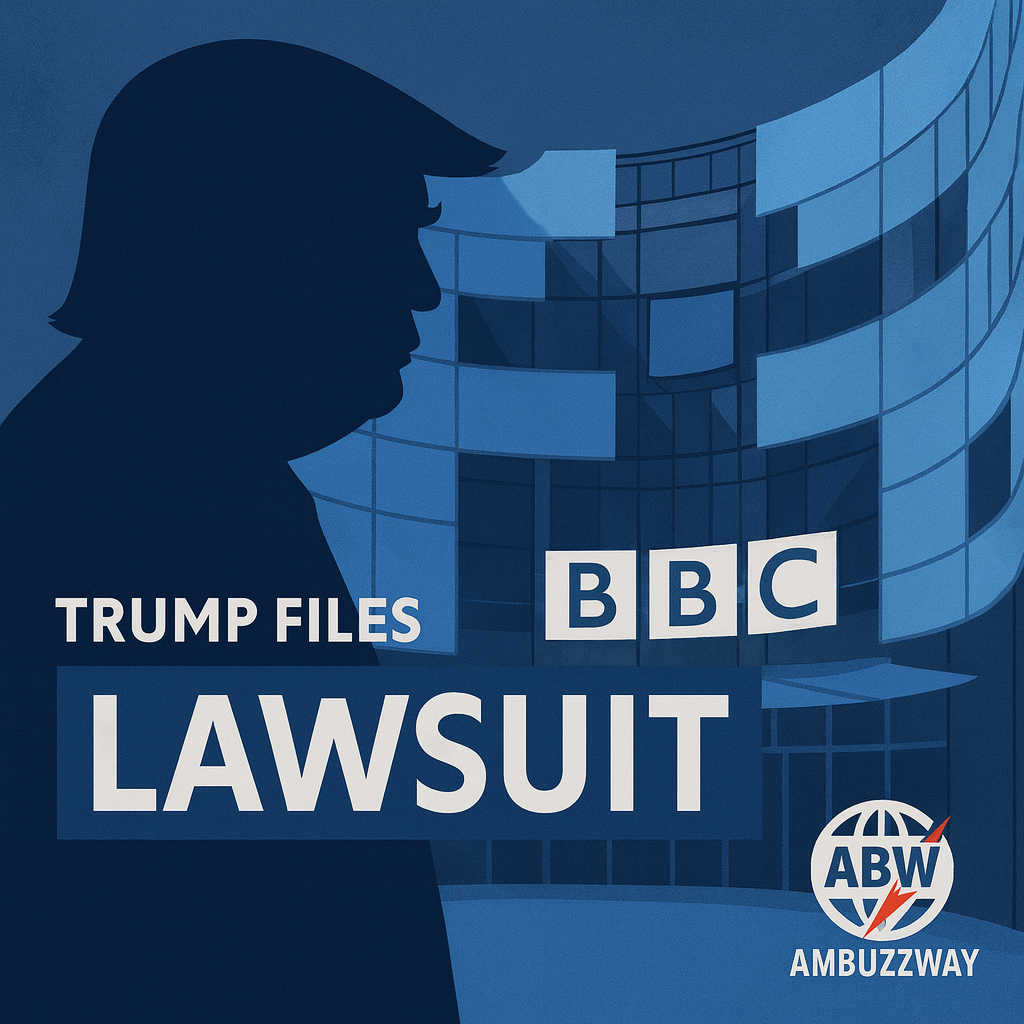
Trump BBC Lawsuit: A Public Broadcaster in the Dock
The Trump BBC lawsuit story is no longer a hypothetical threat. After days of escalating rhetoric, US President Donald Trump has now vowed to sue the BBC for between $1bn and $5bn over an edited clip of his 6 January 2021 speech used in a Panorama documentary. He accuses the corporation of changing “the words coming out of my mouth” and giving viewers a “totally different meaning” of what he said.
The BBC has already apologised, admitting an “error of judgement” in the way the speech was edited and promising not to rebroadcast the programme. But it has firmly rejected Trump’s demand for compensation and insists there is no legal basis for a defamation claim. Reuters+1
That refusal appears to have pushed the conflict into a new phase. Rather than backing down after the apology, Trump has repeated on Air Force One that he will sue for “anywhere between a billion and five billion dollars”, saying he “has to do it” to defend his reputation. Sky News+1
For the BBC, this is not just another media row. It lands at a moment of intense internal and political scrutiny, with director general Tim Davie and the CEO of News Deborah Turness already having resigned over the controversy and wider accusations of systemic editorial bias. Wikipedia+1 At precisely the time the corporation should be preparing for critical negotiations over its next Royal Charter, its leadership is instead bracing for a potentially massive and very public legal fight with the most powerful man in the world.
How a Panorama Edit Sparked the Trump BBC Lawsuit
The roots of the Trump BBC lawsuit lie in an episode of Panorama, Trump: A Second Chance?, broadcast in October 2024, shortly before the US presidential election. The programme revisited Trump’s role in the events of 6 January 2021, when his supporters stormed the US Capitol.
An internal memo later leaked to the press alleged that Panorama had spliced together two separate parts of Trump’s speech:
- One section, early in the speech, in which he said “We’re going to walk down to the Capitol and I’ll be with you…”
- Another, delivered roughly 40 minutes later, where he declared “We fight like hell and if you don’t fight like hell, you’re not going to have a country anymore.” Wikipedia+1
The edited clip was presented as if it were a single continuous statement leading directly into footage of rioters heading toward the Capitol. Critics – including Michael Prescott, a former adviser to the BBC’s Editorial Guidelines and Standards Committee – said that this editing created a misleading impression that Trump had explicitly urged a violent march on Congress. Wikipedia+1
Initially, BBC managers defended the programme, arguing that it is “normal practice” to edit long speeches into shorter clips and insisting there was no attempt to mislead. But as political pressure mounted, the corporation changed course. On 10 November 2025, BBC chair Samir Shah publicly apologised for an “error of judgement”, saying the edit “did give the impression of a direct call for violent action”. Wikipedia+1
Within days, Davie and Turness resigned, citing the need to protect the BBC’s reputation while defending its journalism. The apology helped defuse some political criticism in the UK – but it did not satisfy Trump.
Trump’s Allegations: ‘They Changed the Words Coming Out of My Mouth’
In his public comments, Trump has framed the Trump BBC lawsuit as a clear-cut case of deliberate defamation. He alleges that Panorama “changed the words coming out of my mouth” in order to make it appear that he incited violence at the Capitol. Reuters+1
According to Trump’s legal team, the programme:
- Spliced separate sentences to create a composite line that he never actually delivered in that form;
- Omitted phrases such as “peacefully and patriotically make your voices heard”, which he cites as evidence that he advocated lawful protest; Wikipedia+1
- Juxtaposed the edited clip with riot footage in a way that suggested a direct cause-and-effect relationship between his words and the violence;
- Broadcast the programme shortly before the 2024 US election, allegedly with the aim of damaging his reputation as he attempted a political comeback. Reuters+1
From this perspective, Trump argues that the BBC knowingly or recklessly portrayed him as having issued a direct call to violent insurrection – one of the most serious allegations that can be made against a political leader.
Defamation law requires a claimant to show that a publication contained a defamatory statement of fact, identified them, was communicated to others, and caused or was likely to cause serious harm to their reputation. Trump’s lawyers say the Panorama edit easily meets that bar, and they have demanded not only a formal retraction but massive financial damages. People.com+1
BBC’s Response: Apology, But No Compensation
The BBC has taken a very different view of the Trump BBC lawsuit. In letters to the White House and public statements, the corporation has acknowledged that the edit was wrong and could reasonably have misled viewers. It has apologised to Trump, pledged not to rebroadcast the film, and launched internal reviews of its editorial processes. Reuters+1
But crucially, it has rejected his claim for damages. The BBC says:
- The mistake was an “error of judgement”, not a deliberate attempt to defame;
- The programme was broadcast only in the UK and not on US channels, so any reputational impact on American voters is speculative;
- Trump was elected president again after the film aired, which the BBC argues undercuts claims of serious harm;
- UK defamation law typically awards much smaller sums than the $1bn–$5bn figures Trump is demanding. Reuters+1
In short, the BBC concedes that the edit fell below its standards but insists that this does not translate into a legally actionable, billion-dollar wrong.
Inside the corporation, there appears to have been broad consensus that paying Trump would have been unacceptable, not only because of the sum but because it would involve using licence-fee payers’ money to settle with a politician who routinely attacks the BBC as “worse than fake news”. The Guardian+1
Having drawn that line, however, the BBC has now committed itself to defending the Trump BBC lawsuit vigorously if and when it reaches court.
Where Could the Trump BBC Lawsuit Be Fought?
One of the biggest practical questions is where the Trump BBC lawsuit would actually be heard. Trump has floated the idea of suing for defamation in Florida courts, where he has previously brought actions against US media organisations. People.com+1
But because the BBC is a UK-based public corporation and the Panorama episode aired in Britain, the broadcaster may argue that any case should be tried in the UK. The choice of jurisdiction could fundamentally shape the legal outcome:
1. UK Defamation Law
Historically, English libel law favoured claimants, leading to accusations of “libel tourism”. The 2013 Defamation Act tightened the rules, requiring foreign claimants to show that England is clearly the most appropriate place to bring a case and that the publication caused “serious harm” to their reputation. Damages, while not trivial, are usually in the tens or hundreds of thousands of pounds rather than billions. Reuters+1
If the case were heard in London, the BBC would likely argue that:
- The error was corrected;
- The broadcast reached a relatively limited UK audience;
- Trump’s reputation is shaped far more by domestic US coverage and his own words than by a single Panorama edit.
2. US Defamation Law
In the United States, the First Amendment gives strong protection to media organisations reporting on public figures. Under the landmark New York Times v. Sullivan standard, Trump would have to prove “actual malice” – that the BBC either knew the edited clip was false or acted with reckless disregard for whether it was true.
For an international broadcaster like the BBC, being sued in a US federal court over a UK broadcast would test the reach of US jurisdiction in the digital age. Trump’s team might argue that the programme was available online, including to American viewers, and that BBC journalists knew or should have known that the edit was misleading.
Legal experts already note that Trump has rarely succeeded when suing major media outlets in American courts, although some organisations have settled to avoid prolonged litigation. People.com+1 Regardless of jurisdiction, the BBC is expected to contest both liability and the scale of damages in the Trump BBC lawsuit.
Trump’s Long History of Fighting the Media
To understand why the Trump BBC lawsuit matters, it helps to see it as part of a broader pattern. Throughout his business and political career, Trump has frequently threatened or brought legal action against media organisations he accuses of “fake news” or bias.
Since leaving office in 2021 and returning to politics, he has pursued or announced legal challenges against outlets including CNN, The New York Times and others, often over claims about the 2020 election or his business practices. Some cases have been dismissed; others have dragged on or been settled quietly. People.com+1
Recent reporting suggests that Trump has also reached multi-million-dollar settlements with several US media companies over various disputes, reinforcing his image as a “litigious fellow”, in the words of BBC chair Samir Shah. People.com+1
For Trump’s supporters, this litigiousness is a sign that he fights back against hostile media. For critics, it raises concerns about “lawfare” – using the cost and complexity of legal action as a weapon against press freedom. The Trump BBC lawsuit will inevitably be viewed through that lens.
Stakes for the BBC: Money, Mission and Survival
For the BBC, the stakes in the Trump BBC lawsuit go far beyond whether it ultimately pays damages.
Financial Pressure
Even if Trump’s eye-watering figures are more rhetorical than realistic, defending a cross-border defamation case against a sitting US president will be extraordinarily expensive. Top-flight media and libel lawyers in both the UK and US would be required; the process could drag on for years, tying up significant management time and resources.
Some former BBC executives argue that a quick settlement would have been cheaper in the long run. But others insist that paying a politician under these circumstances would set a dangerous precedent and undermine the corporation’s editorial independence.
Impartiality and Trust
The BBC’s brand rests heavily on the idea of impartiality – being a trusted source of news in a world awash with misinformation. The Panorama edit, and the delayed acknowledgement of its problems, have damaged that reputation at a time when broader allegations of systemic bias are under intense scrutiny. Wikipedia+1
If Trump can successfully present himself as a victim of a corrupt, politically motivated BBC, it will feed narratives in both the UK and US that public broadcasters cannot be trusted. Conversely, if the corporation manages to convincingly defend its overall record while admitting isolated mistakes, it may emerge with its credibility bruised but intact.
Charter Renewal and Political Pressures
All this is happening just as the UK government and the BBC prepare for negotiations over the next Royal Charter, which will determine how the corporation is funded, what its remit is, and how it is governed from 2028 onwards. Reuters+1
Normally, the director general and senior leadership would be devoting all their energy to shaping the BBC’s future. Instead, they have been consumed by the fallout from the Panorama edit and now the looming Trump BBC lawsuit. With Tim Davie stepping down, interim leaders will have to juggle long-term strategic questions with immediate legal crises – not an enviable task.
The Political Dimension: Starmer, Nandy and US-UK Relations
The Trump BBC lawsuit also poses tricky questions for politicians in London and Washington.
UK Prime Minister Keir Starmer has spoken strongly in favour of “an independent BBC”, describing the broadcaster as a vital national institution. But he has been careful not to instruct Trump to drop his legal threat, wary of being seen to interfere in another country’s domestic politics or to undermine judicial independence. The Guardian+1
Culture Secretary Lisa Nandy has defended the BBC robustly, describing it as “a light on the hill for people in times of darkness” and highlighting high levels of public trust in BBC News. At the same time, she has emphasised the need for accountability and strong editorial standards.
For Trump, picking a fight with the BBC serves both legal and political purposes. Domestically, it energises his supporters, who are already suspicious of “mainstream media”. Internationally, it allows him to criticise a prominent foreign institution he has long accused of bias.
Behind the scenes, some observers wonder whether quiet diplomacy might yet defuse the row. Could British ministers use back channels to urge the White House to reconsider? Would Starmer risk expending political capital to ask Trump to move on? So far, there is little sign of that kind of intervention.
Could the Trump BBC Lawsuit Still Be Settled?
Despite the hardline public rhetoric on both sides, there are still theoretical off-ramps from a full-blown courtroom showdown.
Possible scenarios include:
- Enhanced corrections and clarifications: The BBC could offer more detailed on-air and online corrections, perhaps accompanied by a dedicated Panorama segment explaining exactly what went wrong and how editing standards will be tightened.
- Non-financial settlement: Trump might accept a combination of apology, correction and internal reforms in lieu of money – though his repeated references to billion-dollar sums suggest this is unlikely for now.
- Partial legal compromise: The parties could agree to mediation or arbitration to avoid a lengthy trial, potentially limiting damages while allowing both to claim some form of victory.
Yet each of these options comes with risks. For the BBC, offering more concessions might look like capitulation to political pressure; for Trump, backing away from a promised Trump BBC lawsuit could be portrayed by rivals as weakness. That mutual fear of losing face makes a negotiated exit harder.
What Happens Next in the Trump BBC Lawsuit Saga?
In practical terms, the next steps are likely to unfold on several parallel tracks:
- Formal Legal Filings
Trump’s lawyers have indicated that they will file suit “sometime next week”. When that happens, we will learn more about the precise legal claims, which jurisdiction they choose, and whether they target only the BBC or also individual journalists and editors involved in the Panorama episode. Sky News+1 - BBC’s Defence Strategy
The corporation will appoint heavyweight media lawyers and begin assembling its defence: documenting the editing process, internal discussions, compliance checks and the timeline of how concerns were raised and addressed. Its legal team will seek to show that, while mistakes were made, they do not rise to the level of knowing or reckless defamation. - Internal Reform and Public Communication
Regardless of the lawsuit’s outcome, the BBC is likely to tighten its editorial guidelines on the use of composite clips and archive footage. It may also undertake visible training and internal audits to reassure both regulators and audiences that similar errors will not recur. - Charter Renewal Debate
As legal proceedings rumble on, politicians and stakeholders will continue debating the BBC’s future funding model, from the licence fee to potential alternatives. The corporation’s handling of the Trump BBC lawsuit will inevitably feed into those arguments, with critics citing it as evidence of bias and supporters framing it as a reminder of why strong, independent public service media is needed. The Guardian+1 - International Precedent
Finally, the case could set an important precedent for how global broadcasters handle politically sensitive content across jurisdictions. If a UK public broadcaster can be hauled into US courts over a domestic documentary, other outlets may become more risk-averse in covering foreign leaders – with implications for press freedom worldwide.
Conclusion: A Test of Law, Journalism and Power
The Trump BBC lawsuit is about more than a single mis-edited clip. It is a collision between a powerful political figure who feels maligned and a public broadcaster whose legitimacy depends on being trusted to tell the truth.
For Trump, the case offers a chance to punish a media organisation he has long criticised and to reinforce his narrative that “fake news” is out to get him. For the BBC, it is a moment of reckoning over standards, transparency and the costs of even small editorial mistakes in a hyper-polarised age.
In the coming months and years, judges may rule on legal questions of defamation and jurisdiction. But the court of public opinion is already in session. How the BBC responds – how open it is about what went wrong, how robustly it defends its journalism, and how carefully it upholds its own editorial values – will determine whether it emerges from the Trump BBC lawsuit battle diminished, or ultimately strengthened as a “light on the hill” in an increasingly dark media landscape.
EXTERNAL SOURCES FOR REFERENCE
You can list these at the end of your WordPress post as external links for readers who want to explore the Trump BBC lawsuit story in more depth:
- Reuters – BBC apologises to Trump over speech edit but rejects compensation claim Reuters
- BBC News – BBC apologises to Trump over Panorama edit but refuses to pay compensation Wikipedia
- Sky News – Donald Trump confirms he will sue the BBC over Panorama edit – despite broadcaster’s apology Sky News
- People – BBC Refuses to Pay Trump $1 Billion for Editing Jan. 6 Speech People.com
- The Guardian – BBC prepared to apologise to Trump to resolve billion-dollar legal threat The Guardian
- The Guardian (live coverage) – Starmer backs ‘independent BBC’ but declines to tell Trump to drop $1bn lawsuit threat The Guardian
- Al Jazeera – Trump threatens BBC with $1bn lawsuit over edited January 6 speech Al Jazeera
- Wikipedia – 2025 BBC editorial bias allegations (background on Panorama edit and internal memo)