
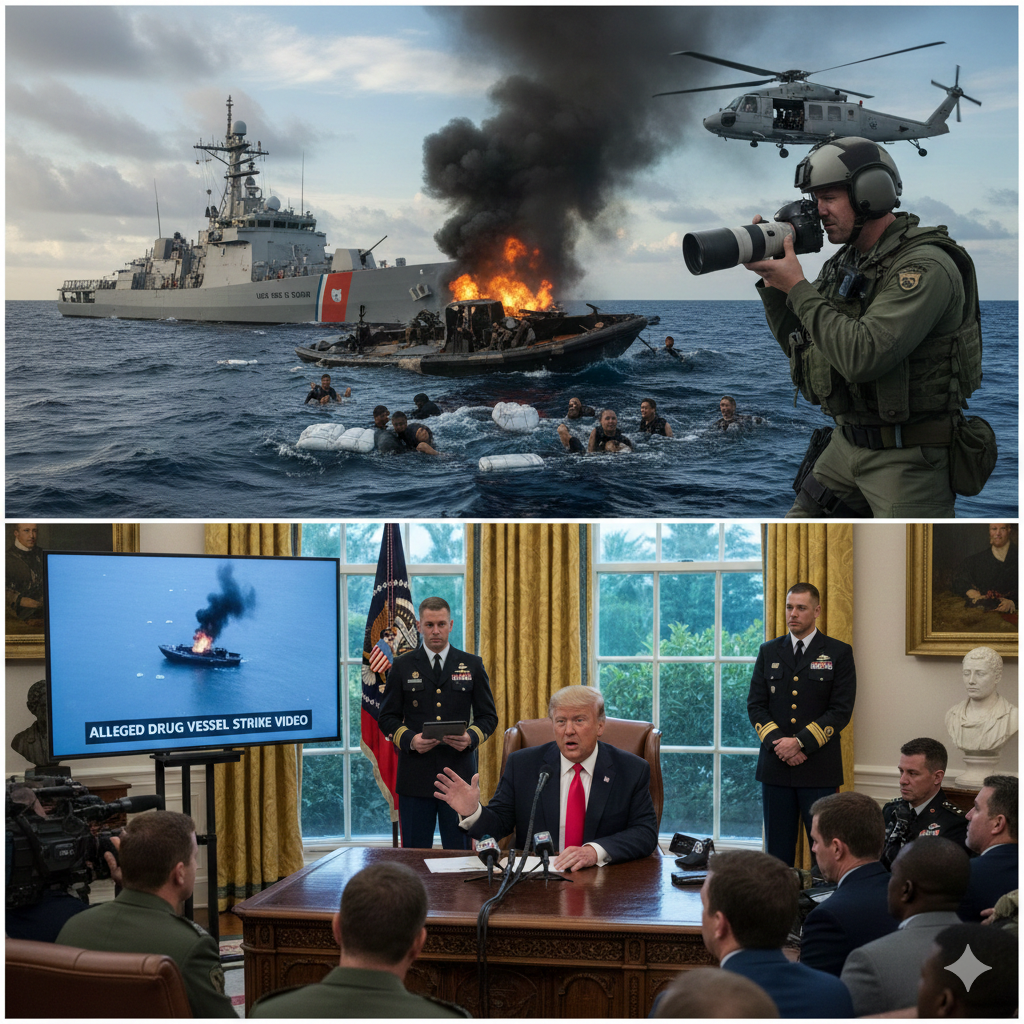
In a significant statement from the Oval Office, President Donald Trump confirmed on Wednesday that his administration would “certainly” release the video footage of a follow-up strike on an alleged drug-smuggling vessel in the Caribbean. The controversial operation, which took place in September, involved an initial military strike followed by a subsequent action targeting survivors clinging to the wreckage. This announcement, centering on the potential release of the Trump Drug Vessel Video, reignites a crucial national conversation about maritime drug interdiction, the rules of engagement for U.S. forces, and the broader political strategy in the war against drug trafficking.
The initial video of the operation was previously shared by the President on his Truth Social platform, a move that brought the relatively standard, albeit high-stakes, operation into the immediate public spotlight. However, the subsequent revelation of a second strike, reportedly ordered because the first did not neutralize all individuals on board, has introduced a new layer of scrutiny, prompting questions from the press regarding the justification for the use of lethal force against potential survivors. The President’s unequivocal defense of the military’s actions and his casual dismissal of accountability questions concerning Defense Secretary Pete Hegseth and Adm. Frank “Mitch” Bradley are central to this developing story.
This deep dive examines the President’s full remarks, the history and current state of maritime interdiction operations, the legal and ethical frameworks guiding these actions, and the broader implications of these policies on international relations and the ongoing effort to secure America’s borders from narcotics trafficking. Understanding the context behind the Trump Drug Vessel Video is essential to appreciating the complexity of modern anti-smuggling warfare.
The President’s Defense and the Context of the Second Strike
When questioned by reporters about the incident, President Trump offered a clear, unreserved defense of the actions taken by the military personnel involved.
“I don’t know what they have, but whatever they have, we’d certainly release, no problem,” Trump stated, addressing the potential release of the second Trump Drug Vessel Video. He framed the operation not merely as law enforcement, but as a crucial defense of the nation: “You know, we stopped — every boat we knock out, we save 25,000 American lives.” This high-stakes rhetoric immediately elevates the discussion from a procedural military action to a vital matter of national security and public health, linking the interdiction directly to the opioid crisis and the devastating impact of illegal drugs on American communities.
Addressing the Killing of Survivors
The core of the controversy lies in the alleged second strike targeting individuals who survived the initial attack. Pressed on whether he supported the decision to kill survivors, the President was direct, though he reframed the goal. “No, I support the decision to knock out the boats, and whoever is piloting those boats. Most of them are gone, but whoever’s piloting those boats, they’re guilty of trying to kill people in our country.”
This statement provides a crucial insight into the administration’s mindset regarding these operations. It suggests a policy framework where the vessel and its crew are viewed as combatants in a larger war against drug importation, rather than criminals who must be apprehended according to traditional law enforcement protocols. The distinction between “law enforcement” and “war” is not merely semantic; it has profound implications for the rules of engagement and the legal justification for the use of force, especially lethal force.
Warfare or Interdiction? The Legal Conundrum
President Trump dismissed questions of punishment for the officials allegedly ordering the second strike, framing the entire event as a function of war. “I think you’re going to find that this is war, that these people were killing our people by the millions,” Trump asserted.
This “war” designation—a theme consistently promoted by the administration—allows for a different set of legal standards than those applied in peacetime law enforcement. In a traditional law enforcement setting, the use of lethal force is strictly limited to self-defense or the defense of others from imminent harm. In a military, “war” context, the focus shifts to neutralizing a threat to achieve the mission objective. The President’s concluding remark, “And very soon, we’re going to start doing it on land too,” suggests a potential future escalation of anti-drug operations, further blurring the lines between military action and domestic/international law enforcement.
Historical Context: Maritime Drug Interdiction Operations
The U.S. has a long and complex history of attempting to stop the flow of illegal narcotics across its maritime borders. These operations are primarily conducted by the U.S. Coast Guard, often with support from the Navy, Customs and Border Protection (CBP), and allied nations.
Operation Martillo and the Caribbean Corridor
The alleged drug vessel strike is part of a much larger, ongoing effort. The Caribbean has historically been a critical transit point for cocaine originating in South America and destined for North America and Europe. Operations like Operation Martillo (a multinational effort to disrupt illicit trafficking routes) rely heavily on surveillance and interdiction tactics. The sheer volume of traffic and the vastness of the area necessitate quick, decisive action.
Maritime drug smugglers—often utilizing “go-fast” boats, fishing vessels, or even sophisticated Low-Profile Vessels (LPVs) and Self-Propelled Semi-Submersibles (SPSSs), colloquially known as “narco-subs”—are highly motivated and often armed. Their standard procedure upon detection is to jettison their cargo and attempt evasion or, in rare cases, engage in armed resistance. The Coast Guard’s primary mission is to stop the vessel, secure the cargo, and detain the crew.
The Role of the U.S. Coast Guard
The U.S. Coast Guard (USCG) operates under a unique blend of military and law enforcement authority. They have the ability to board and inspect vessels in international waters under various agreements and treaties. When dealing with non-compliant vessels, the USCG employs a standardized Use of Force Continuum, which includes warning shots, disabling fire (aimed at the engines), and, as a last resort, direct fire.
The key legal framework is the Maritime Drug Law Enforcement Act (MDLEA), which gives the U.S. jurisdiction over certain drug-smuggling vessels in international waters. The legality of the initial and subsequent strikes rests heavily on whether the vessels were classified as “hostile” and whether the use of force was proportionate and necessary to achieve the mission and protect U.S. personnel.
The Rules of Engagement and the Law of Armed Conflict (LOAC)
The core legal debate surrounding the potential Trump Drug Vessel Video involves the applicable legal framework.
Peacetime vs. Hostilities
If the operation is strictly defined as law enforcement (a peacetime operation), the rules governing the use of force are restrictive. Even if a vessel is non-compliant, lethal force can only be used to prevent a direct, imminent threat to life. Shooting at unarmed individuals, even if they are drug smugglers, would be highly scrutinized under this standard.
If the operation is designated as an act of war or hostilities (as the President suggests), the Law of Armed Conflict (LOAC), also known as International Humanitarian Law (IHL), applies. Under LOAC, personnel on a military objective (such as a drug vessel deemed a hostile asset) can be targeted. The crucial question then becomes: At what point do surviving individuals cease to be combatants and become non-combatants/prisoners?
Once a vessel is disabled and its crew is clearly no longer capable of resistance or evasion (e.g., clinging to wreckage), the obligation shifts, under LOAC, to respect and protect those rendered hors de combat (out of the fight). The allegation that a second strike targeted survivors directly challenges the principle of Distinction and Humanity under the LOAC. This is the crucial legal and ethical line that the second strike may have crossed, regardless of the President’s assertion that “this is war.”
The Precedent of Warning Shots and Disabling Fire
Before employing direct lethal force, Coast Guard and Naval vessels are generally required to escalate through a sequence of actions: visual signals, radio warnings, running parallel to the vessel, and finally, disabling fire (aimed at engines or propulsion). The first strike video released by the President showed an action that appeared to be aimed at disabling the vessel. The subsequent action—the alleged second strike—suggests that the crew was still considered a threat, even in the water, or that the military objective was redefined to include the complete elimination of all personnel, which would be an extremely aggressive and potentially illegal interpretation of the rules of engagement.
The release of the full Trump Drug Vessel Video is crucial because it would provide the necessary visual evidence to assess:
- The vessel’s state of compliance or resistance after the first strike.
- The perceived threat level posed by the individuals in the water.
- The exact nature and target of the second strike.
Political and International Repercussions of the Trump Drug Vessel Video
The President’s defense of the operation has immediate political ramifications, both domestically and internationally.
Domestic Political Stance
Domestically, the President’s comments play directly into a hardline stance on border security and the drug crisis, themes that resonate strongly with his political base. By equating drug smugglers with “people who are trying to kill our people by the millions,” he mobilizes public support for aggressive, unrestrained military action against trafficking. The administration frames this as necessary decisiveness, contrasting it with what they might characterize as overly cautious, bureaucracy-laden operations under previous administrations.
The decision to name military officials (Hegseth and Bradley) and then dismiss the idea of punishing them is a potent political signal of absolute presidential backing, insulating personnel from criticism or investigation. This serves to reinforce the image of a Commander-in-Chief who will authorize and defend tough actions in the name of national security.
International Legal Scrutiny
Internationally, the controversy surrounding the Trump Drug Vessel Video could lead to significant blowback. Drug interdiction often occurs in international waters or in the territorial waters of partner nations (e.g., Caribbean island states).
- Sovereignty: The willingness to conduct aggressive strikes could strain relations with allies, particularly if there are questions about jurisdiction or if the individuals killed are nationals of a third country.
- Law of the Sea: International law, including the UN Convention on the Law of the Sea (UNCLOS), governs freedom of navigation and the right of hot pursuit. While MDLEA provides a legal basis for U.S. action, the rules of engagement must still adhere to international norms regarding the use of force, especially the treatment of persons hors de combat.
- Precedent: The perception that U.S. forces are willing to execute survivors in the water sets a dangerous precedent. It could be used by other nations to justify their own aggressive maritime actions and erode the international legal framework designed to protect combatants who surrender or are incapacitated.
The official release of the video, though intended to demonstrate transparency and strength, will simultaneously open the operation up to international legal and ethical examination, including potential reviews by human rights organizations and international courts.
The Strategy of Escalation: “Doing it on Land Too”
Perhaps the most alarming part of the President’s statement was his conclusion: “And very soon, we’re going to start doing it on land too.” This suggests a major policy shift, hinting at an unprecedented escalation of U.S. military or quasi-military action against drug cartels outside of established war zones.
Potential Areas of Operation
The most likely targets for such an escalation would be key transit and production hubs, primarily in Mexico and Central/South America. For years, certain U.S. political figures have advocated for classifying drug cartels as Foreign Terrorist Organizations (FTOs). Such a designation could legally pave the way for cross-border military strikes—including drone operations or special forces raids—similar to those conducted against groups like ISIS or Al-Qaeda.
Legal and Diplomatic Hurdles
Launching military strikes on foreign soil to target drug operations, especially within the territory of an ally like Mexico, represents a monumental diplomatic challenge and a massive violation of national sovereignty. Any such operation would require the explicit (or tacit) approval of the host government or, failing that, would risk a major international crisis. The legal justification would have to be an extremely broad interpretation of self-defense, arguing that the cartels represent an imminent, existential threat to the U.S. that sovereign nations are unwilling or unable to contain.
The President’s promise to take the fight to the land, following the precedent set by the actions on the sea, highlights a dangerous trajectory toward an increasingly militarized approach to the drug crisis, one where the traditional boundaries of international law and diplomatic partnership are increasingly challenged. The debate over the Trump Drug Vessel Video is therefore not just about a single strike; it’s a window into the future of American foreign and military policy regarding the entire Western Hemisphere.
Analyzing the Impact: The War on Drugs and Its Cost
The controversy surrounding the vessel strike must be viewed within the larger framework of the decades-long War on Drugs, a conflict that has cost billions of dollars and countless lives without decisively ending the flow of narcotics into the U.S.
The administration argues that aggressive interdiction is necessary because the conventional methods—aid, training, and traditional law enforcement—have been insufficient to stem the tide. They see the drug vessel as a hostile supply line that must be severed with maximum force.
However, critics argue that military escalation, especially actions like the alleged second strike, is a failure of diplomacy and intelligence. They contend that the use of extreme, potentially extrajudicial force alienates allies, violates international norms, and, most importantly, does not address the fundamental economic and social issues that fuel drug production and demand. The use of lethal force against drug mules and transporters does little to dismantle the sophisticated criminal organizations that orchestrate the global trade.
The release of the Trump Drug Vessel Video would serve as a definitive statement on where the administration draws the line—or, perhaps, where it believes no line should be drawn—in its pursuit of disrupting drug routes. It will force a national discussion on whether the immediate goal of stopping a single shipment justifies the potential breach of the fundamental laws of armed conflict and international human rights.
The Need for Transparency and Accountability
In any military operation, especially one resulting in the loss of life and conducted outside of a formally declared war, transparency is paramount. The initial release of the first video created high expectations for disclosure. The President’s commitment to releasing the second Trump Drug Vessel Video is thus a necessary step toward accountability. However, the video alone may not be enough. A full, independent investigation into the rules of engagement, the immediate threat assessment, and the chain of command that led to the second strike is essential to ensuring that U.S. forces operate within the strict legal and ethical parameters that define a civilized military.
Conclusion: Beyond the Video
The incident involving the alleged drug vessel and the President’s subsequent statements are far more than a fleeting news cycle. They represent a collision of national security policy, the Law of Armed Conflict, and domestic political rhetoric. The commitment to releasing the Trump Drug Vessel Video will bring critical facts to light, but the ensuing debate must focus not just on the images themselves, but on the profound policy implications they reveal. The question is not simply whether the operation was successful in stopping a drug shipment, but whether the means employed were consistent with the values and laws the United States purports to defend. The answer will shape not only future maritime interdiction efforts but also the very nature of the American approach to fighting the global war on drugs.
External Sources Links (For Reference)
- U.S. Coast Guard: (To link to official USCG page on drug interdiction or Operations Martillo) *
- U.S. Department of Justice / DEA: (To link to reports on Caribbean drug trafficking and the opioid crisis statistics)
- Congressional Research Service (CRS) Reports: (For neutral, in-depth analysis of MDLEA and Law of the Sea)
- International Law/Human Rights Watch: (To link to analysis of the Law of Armed Conflict (LOAC) and the treatment of hors de combat individuals)
- UN Convention on the Law of the Sea (UNCLOS) / UN Office on Drugs and Crime (UNODC): (To link to relevant international frameworks and reports)
- Official White House/Pentagon Press Briefings: (To link to official transcripts or releases related to the operation or the officials mentioned)