
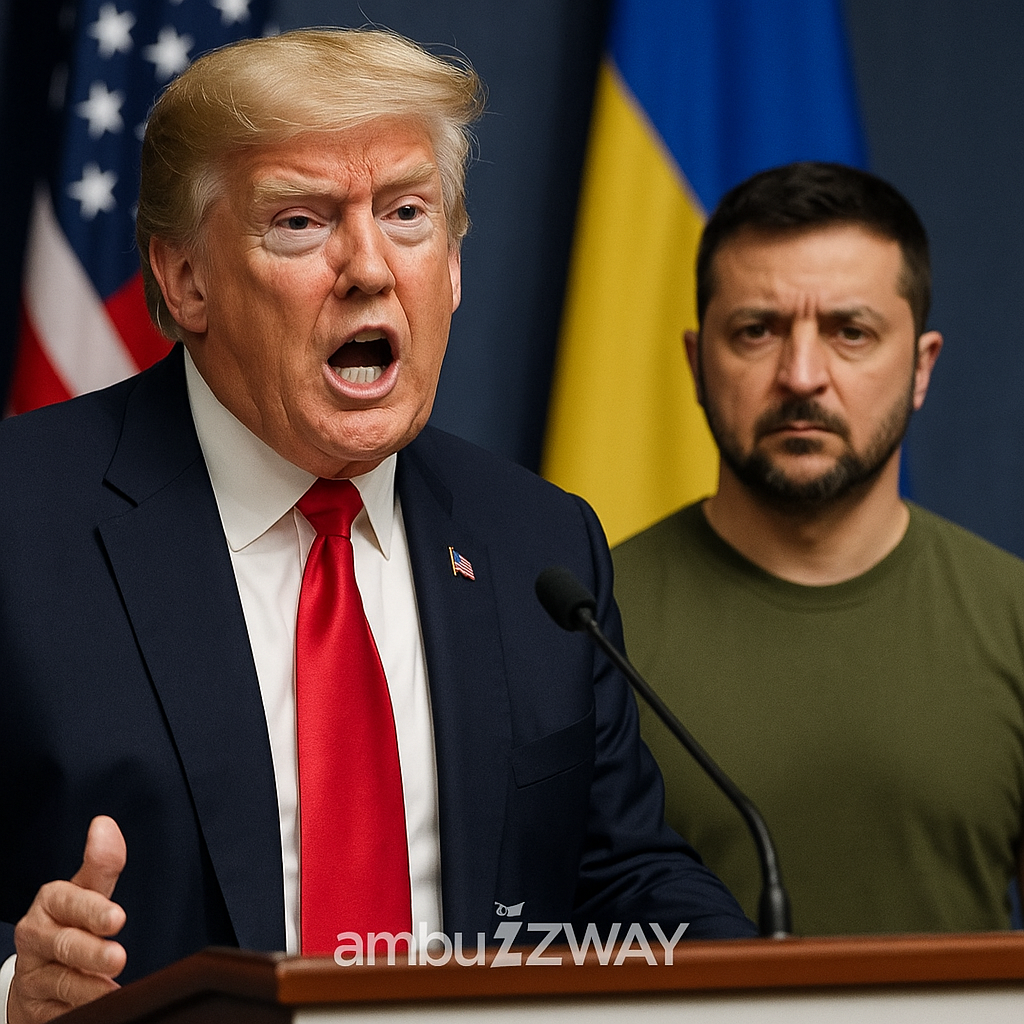
Trump Says Ukraine Ungrateful as Peace Talks Hit Turbulence
Trump says Ukraine ungrateful – and with that all-caps post on Truth Social, the fragile optimism around a potential peace deal in Geneva suddenly evaporated.
For days, diplomats from the United States, Ukraine and key European allies have been meeting behind closed doors at a Geneva hotel, trying to hammer out the details of a 28-point US-proposed peace plan to end Russia’s full-scale war on Ukraine. Ukrainian officials spoke cautiously of “momentum”. American envoys briefed that talks were focused on “ironing out difficult details”.
Then, as negotiations paused and US Secretary of State Marco Rubio briefly left the 18th-floor suite, the president weighed in from Washington.
“UKRAINE ‘LEADERSHIP’ HAS EXPRESSED ZERO GRATITUDE FOR OUR EFFORTS, AND EUROPE CONTINUES TO BUY OIL FROM RUSSIA.”
In a few lines, Trump said he had inherited a war that “should have never happened” and that Ukraine’s leaders had shown “zero gratitude” for US support and diplomacy. The message hit Geneva like a cold blast of air: the faint hopeful mood surrounding the talks seemed to disappear, and the US delegation left the hotel tight-lipped, refusing to answer shouted questions.
Trump says Ukraine ungrateful at the very moment Kyiv is trying to signal flexibility on the plan – and the clash highlights how fragile this entire peace effort really is.
Geneva Talks: A Controversial 28-Point Peace Plan
The negotiations in Geneva are centred on a 28-point plan drawn up by the Trump administration. On paper, it is meant to be a roadmap to a “real and lasting peace” – a phrase repeated in public by both US and Ukrainian officials.
In practice, the plan is widely viewed as tilted towards Russia’s core demands. According to diplomats who have seen drafts, the proposal includes:
- Ukrainian recognition of current front lines, effectively conceding some Russian-occupied territory
- A long-term ban on Ukraine joining Nato, coupled with non-alignment clauses restricting Kyiv’s military choices
- Limits on the size and range of Ukraine’s armed forces and missile capabilities
- A phased relaxation of some sanctions on Russia once specific benchmarks are met
For many in Kyiv, and for Ukraine’s European partners, these elements feel dangerously close to rewarding aggression. Western leaders issued a joint statement at the G20 summit in Johannesburg warning that the plan, in its current form, would “leave Ukraine vulnerable to attack” and would need “substantial additional work” before it could form the basis of a just peace.
Yet Ukraine has little choice but to engage. Trump has given Kyiv a deadline – Thanksgiving Thursday – to sign up to the plan, while insisting that the date is “appropriate” but not necessarily final if “things are going well”. Privately, Ukrainian officials acknowledge that if they walk away entirely, they risk losing the American security guarantees that underpin their defence.
So the Geneva talks are about modifying, clarifying and inserting as many Ukrainian priorities as possible into a document Washington clearly wants signed.
Zelensky’s Balancing Act: Gratitude and Red Lines
The charge that Ukraine is ungrateful stings precisely because Volodymyr Zelensky has spent the last two years going out of his way to avoid that perception.
Back in early 2023, in a tense Oval Office meeting, Republicans on Capitol Hill berated the Ukrainian president for not saying “thank you” often enough. Since that humiliating episode, Zelensky has over-corrected, repeatedly opening speeches with lengthy lists of thanks to the US Congress, the White House and individual allies.
That habit was on display again even as Trump says Ukraine ungrateful. Shortly after the president’s post, Zelensky wrote on X that he was “grateful to every leader and to everyone around the world who supports Ukraine and our principled stances”. He described a joint call with the prime ministers of Croatia and Luxembourg, saying he had briefed them on “our diplomatic work on the American proposal and the meetings in Geneva”.
In another message, the Ukrainian leader emphasised that there was now an understanding that the US peace plan could incorporate “a number of elements that are based on the Ukrainian vision and are critical to Ukraine’s national interests”. He stressed that further work was needed to ensure the proposal actually “put an end to the bloodshed and war”.
Zelensky is walking a tightrope:
- He must show his own public, and the soldiers still fighting and dying on the front lines, that he is not capitulating to an imposed deal.
- He must show European allies that Ukraine’s voice is being heard.
- And he must show Washington – especially a volatile president – that Kyiv is genuinely engaging with US diplomacy.
When Trump says Ukraine ungrateful, he is striking at that delicate balancing act.
Ukrainian Officials: ‘We Appreciate Our American Partners’
If Zelensky’s tone was diplomatic, his top aides were even more explicit in rejecting the president’s claim.
Rustem Umerov, Ukraine’s national security secretary, used a Telegram post to echo Zelensky’s cautiously positive message from Geneva. He said that the latest working draft of the plan “includes many Ukrainian priorities” and that Kyiv “appreciate[s] our American partners working closely with us to understand our concerns”.
“We expect to make more progress today,” Umerov wrote, just minutes after Trump accused Ukrainian leaders of “zero gratitude”.
Andriy Yermak, the powerful head of the presidential office, described the first round of talks with European advisers as “very constructive” and promised that Ukraine would “continue to work together to achieve a sustainable and just peace”.
These statements underscore the gap between the president’s rhetoric and what his own diplomats and military officials are doing on the ground. In Geneva’s Intercontinental Hotel, negotiators were still poring over clauses, commas and footnotes even as Trump says Ukraine ungrateful in capital letters back in Washington.
European Scepticism: ‘Borders Cannot Be Changed by Force’
If Trump’s social-media outburst chilled the mood in Geneva, European leaders had already made clear that they were uneasy with the entire 28-point framework.
At the G20 summit in Johannesburg, presidents and prime ministers from Canada, the UK, France, Germany, Japan, Italy, Spain, the Netherlands, Norway, Finland and Ireland – along with senior EU officials – issued a rare joint statement. While acknowledging that the US plan contained “elements essential for a just and lasting peace”, they warned that, as drafted, it would “leave Ukraine vulnerable to attack”.
European Commission president Ursula von der Leyen spelled out the bloc’s red lines:
- Ukraine’s borders “cannot be changed by force”;
- Any deal must avoid capping Ukraine’s armed forces in a way that leaves it “vulnerable to future attack”;
- The EU’s central role in guaranteeing Ukraine’s security and eventual membership “must be fully reflected”.
She also demanded the return of “each and every Ukrainian child abducted by Russia”, stressing that tens of thousands remain illegally taken from their homes.
German chancellor Friedrich Merz went even further, saying he was “sceptical” that a deal could be reached by Trump’s Thursday deadline and that the parties were “very far” from an outcome acceptable to Kyiv. For Merz, the focus should be on drafting a document that Ukraine can accept as a starting point for talks with Russia – not on rushing to satisfy a political timeline in Washington.
Canadian prime minister Mark Carney struck a wry note, saying that his country “likes point number one, Ukraine as a sovereign nation – that is a good start”, but adding that national security advisers were following up with the White House on serious concerns.
In other words: Europe wants peace, but not at any price. And while Trump says Ukraine ungrateful, many European leaders worry that Washington’s impatience could force Kyiv into a lopsided settlement.
Deadline Diplomacy and Quiet Threats
Complicating all of this is Trump’s self-imposed deadline. Kyiv has been given until Thanksgiving to accept the broad contours of the 28-point plan.
Officially, the president says the date is “appropriate” but not absolute; he has hinted that if “things are going well” in Geneva, deadlines could be extended. Unofficially, there are widespread reports that the US has warned Ukraine that intelligence sharing and weapons deliveries could be curtailed if Kyiv refuses to engage in the process or rejects it outright without offering alternatives.
From Kyiv’s perspective, this feels uncomfortably like coercion. Ukrainian officials insist that they are ready for serious diplomacy, but only on terms that respect their sovereignty and do not reward Russia’s use of force.
The message from the front line is even blunter. Unit commander Vitalii Traikalo, speaking to Reuters reporters, posed the question many soldiers are now asking:
“Why are we fighting then? Are we defending our borders here just to give them away? What’s the point of all this, of all these sacrifices?”
Traikalo described drones as the “nightmare” of the battlefield and expressed deep distrust of Russia’s intentions. Any plan that requires Ukraine to abandon land its soldiers died defending will be extremely hard to sell to those still in the trenches.
On the Ground in Ukraine: War Still Rages
While diplomats talk and Trump says Ukraine ungrateful, the war on the ground has not paused.
In the western city of Ternopil, Zelensky announced the end of a grim rescue mission after a Russian strike on a residential building killed 33 people and left six missing. Across the country, he said, Russian forces have launched more than 1,050 strike drones, nearly 1,000 guided bombs and over 60 missiles of different types in just a week.
These attacks, targeting cities far from the front lines, reinforce Zelensky’s message that any peace deal must include solid guarantees to deter future aggression and robust air-defence commitments from allies. “In parallel with the diplomatic track,” he wrote, “we must do everything to strengthen our defence.”
For ordinary Ukrainians, the images are familiar: smashed apartment blocks, smoke rising from cratered courtyards, dazed residents wrapped in blankets. The war is not a distant abstraction but a daily reality, and that reality shapes how any compromise will be judged.
What’s Actually in the 28-Point Plan?
The full text of the US proposal has not been published, but various leaks and diplomatic comments offer a rough outline. Key elements reportedly include:
- A ceasefire along current lines of control.
- Formal recognition of those lines for a defined interim period, pending negotiations on final borders.
- A commitment by Ukraine not to join Nato, in exchange for a package of security assurances from the US and key European states.
- Limits on the deployment of long-range missile systems by both sides near the new line of contact.
- A staged withdrawal of some Russian forces from certain areas, tied to sanctions relief.
- International monitoring of ceasefire compliance and prisoner exchanges.
- Frameworks for compensation and reconstruction funds, backed by frozen Russian assets and international donors.
Critics say the plan dedicates more detail to military freezes and sanctions relief than to justice for war crimes or the fate of occupied populations. Provisions on deported Ukrainian children, political prisoners and accountability mechanisms are said to be vague.
For Kyiv, the challenge is to reshape these 28 points so that they reflect Ukraine’s vision of a just peace – not simply Russia’s wish list dressed up in diplomatic language.
When Trump says Ukraine ungrateful for US efforts, Ukrainian officials quietly note that they are the ones who will have to live with whatever document is signed, long after American political cycles move on.
Trump’s Narrative of Ingratitude
The accusation of ingratitude is not new.
Trump first publicly complained about Zelensky’s supposed lack of gratitude more than two years ago, when congressional Republicans were holding up fresh aid and demanding more vocal thanks from Kyiv. That led directly to the awkward Oval Office encounter in which Zelensky was perceived as being lectured on manners while his country fought for survival.
Since then, the Ukrainian president has made a point of thanking the US at every opportunity. He has praised Trump’s efforts to pursue peace, expressed appreciation for arms packages and sanctions, and gone out of his way to emphasise that Ukraine sees the US as its indispensable ally.
Against that backdrop, when Trump says Ukraine ungrateful now, many observers see it less as a literal complaint and more as a political tactic – a way to signal to his domestic base that he is the one in control, putting pressure on foreign leaders and demanding respect. It also sets the stage for blame-shifting if the 28-point plan fails: the White House can say it tried, but that Ukrainians were ungrateful and Europeans were too soft.
For Zelensky, however, being cast as the ungrateful partner is dangerous. It risks eroding sympathy among some US voters and lawmakers, precisely when continued support is most critical.
Can a Deal Still Be Done?
Despite the sharp rhetoric, diplomats insist that the Geneva talks are not dead. US officials stress that Secretary of State Rubio and special envoy Steve Witkoff remain “fully engaged” and that today’s meetings are about “ironing out details”, not delivering ultimatums.
In practical terms, several paths remain:
- Revisions and clarifications: Ukrainian and European negotiators may secure enough changes to the plan – on borders, security guarantees and military caps – to claim that their core concerns have been addressed.
- Extended talks: If progress is visible but incomplete by Thursday, Trump could decide that “things are going well” and extend the deadline, avoiding an immediate crisis.
- Stalemate and blame: If talks stall and the president feels Kyiv is dragging its feet, he could cut off some forms of support, blaming Ukrainian ingratitude and European hypocrisy.
Much depends on what Trump ultimately wants: a genuine, sustainable peace agreement with a broad coalition behind it, or a quick headline victory he can sell at home regardless of the long-term consequences.
For now, all sides are staying in the room. But the mood has changed. When Trump says Ukraine ungrateful in capital letters, it injects mistrust into a process that was already strained by clashing priorities.
Conclusion: Gratitude, Power and the Price of Peace
The image of this moment is not a handshake or a signing ceremony, but a split-screen.
On one side, a war-time president in olive-green T-shirt speaks of gratitude, of “positive results” and “real and lasting peace”, while his people endure missile strikes and drone attacks. On the other, another president in a suit and red tie taps out a social-media post declaring that Ukraine’s leaders have shown “zero gratitude” and reminding the world that he inherited a “loser” war.
Between them, in a Geneva hotel, diplomats shuffle between conference rooms, drafting and redrafting a 28-point document that could shape Europe’s security for a generation.
Trump says Ukraine ungrateful. Zelensky says thank you. Soldiers on the front line ask why they are still fighting if land will be conceded anyway. European leaders warn against a quick fix that plants the seeds of future conflict.
Whether this moment leads to a historic peace settlement or a bitter breakdown will depend on more than just words about gratitude. It will hinge on hard choices about borders, security guarantees, justice and the balance between ending the killing now and preventing a new war later.
For Ukrainians who have buried loved ones and rebuilt homes under constant threat, gratitude is not the issue. Their question is simpler, and far more difficult to answer: What kind of peace is worth the price they have already paid?
EXTERNAL SOURCES FOR REFERENCE
- BBC News – Live coverage of US-proposed Ukraine peace plan and Geneva talks
- Reuters – Analysis of the 28-point US peace proposal and European reaction
- Associated Press – Reports on frontline Ukrainian soldiers’ views of potential land concessions
- European Commission – Statements by Ursula von der Leyen on Ukraine’s borders and EU role in peace
- Ukrainian presidential website – Official speeches and posts by Volodymyr Zelensky on the Geneva negotiations